Petersen Instruments Part 1 - The VFTB
I launched the first series of devices that became products while I was still going to Highschool in Munich, Germany. The idea and overall concept for these devices came from my dad who’s a professor at LMU Munich. As a geophysicist he’s interested in the magnetic characteristics of geological and biological samples. For the purpose of measuring the magnetism of such samples we developed two devices together, the variable field translation balance or VFTB, and the bacteriodrome that later became the magnetodrome.
The variable field translation balance (VFTB) suspends a rock sample on a miniature swing and then actuates the sample using a magnetic gradient field. The sample is magnetized by an superimposed stronger electromagnetic field. The response motion of the sample to a sinusoidal actuation is measured and from it the amount of magnetization calculated.
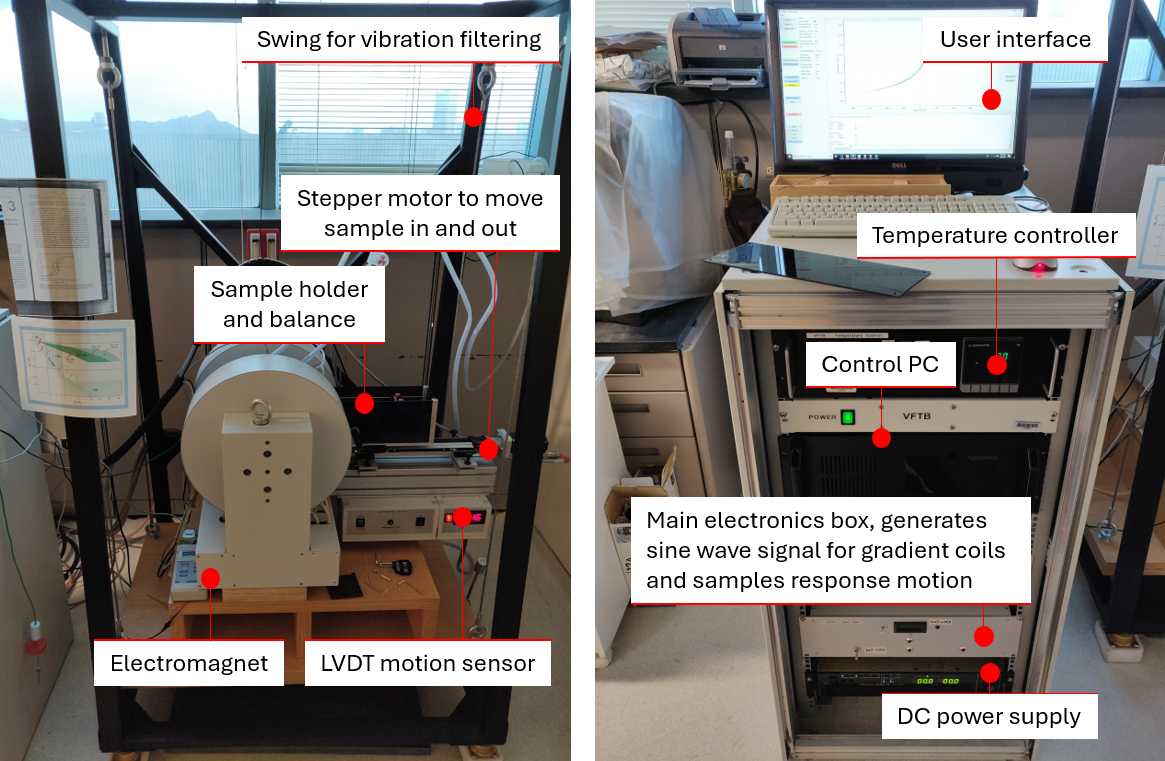
Building this device together with my dad as a teenager was a very educational but also super fun experience. The photo above shows the VFTB we installed at the University of Hawaii Manoa. My dad and his friend Bill, a brilliant electronics engineer, developed the hardware parts of the VFTB, whereas I wrote the software to control the device. These were the times of MS-DOS and I developed the first version of the control software in a C++ dialect called Turbo C++, created by a company named Borland. While the company Borland itself was acquired and the name eventually abandoned as far as I know, interestingly, Turbo C++ still is still around in a incarnation called C++ Builder . See below a schematic overview of the different components of the measurement system itself.
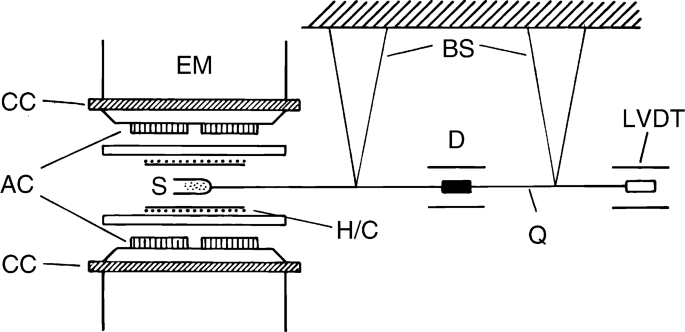
| Key | Description |
|---|---|
| CC | Electromagnetic coils to magnetize sample |
| AC | Gradient coils to actuate sample motion |
| H/C | Heating / cooling element |
| S | Rock sample |
| Q | Quartz glass sample holder |
| BS | Bifilar suspension |
| LVDT | Motion pickup sensor |
| D | Sample fixture |
Even though Windows and other graphical user interfaces like Digital Research’s GEM for the DOS platform already existed, they weren’t very popular yet. Therefore one of the most fun parts about the initial stages of the VFTB product development were that I’d have to code the graphical user interface under DOS by myself, if we didn’t want customers to operate the device from the command line. This meant frequent sessions with my dad or his students at the lab to get feedback about the user experience and making the whole application useful. The result was very rudimentary in terms of GUI functionality, but a useful, simple interface for controlling the system.
As the application needed to operate the various sub-devices of the instrument, this required communication with hardware such as the temperature controller via various interfaces, mainly the multiple COM ports of the control PC. The system also included an A/D converter card built into the computer as 16-bit ISA extension card.
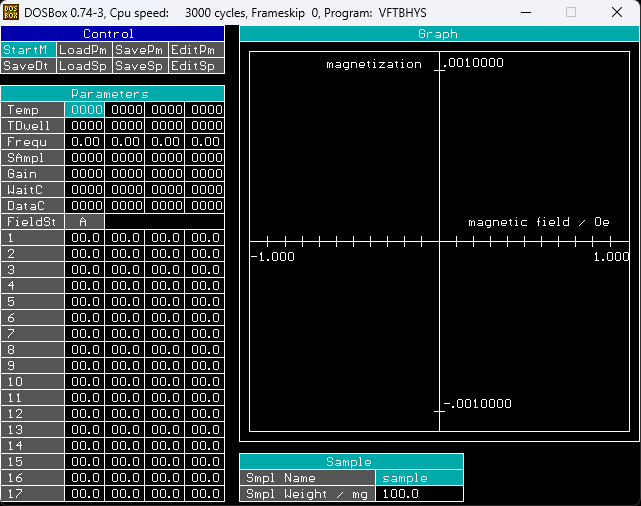
Below is a screenshot of the original VTFB Control application running in a DOSBox emulator. Unfortunately, without access to one of the old machines, I don’t have any images of this software running an actual measurement.
After a while we were installing VFTBs all over the world. Not in huge numbers, building the VFTB was never about commercial success, it was about providing a uniquely sophisticated measurement device to the research community. Some of the first systems went to the UK, to Oxford University, to Liverpool University and to the University of Southampton. Key for the sale and distribution of the systems was my dad’s colleague, a professor at Liverpool university who founded his own business Magnetic Measurements to build and distribute devices in the field of Geophysics. In the coming years we made it all the way to Australia, India, China and Hawaii. It was fantastic! Apart from the technological challenge working and travelling with my dad, occasionally my mom would also join, was a wonderful family experience.
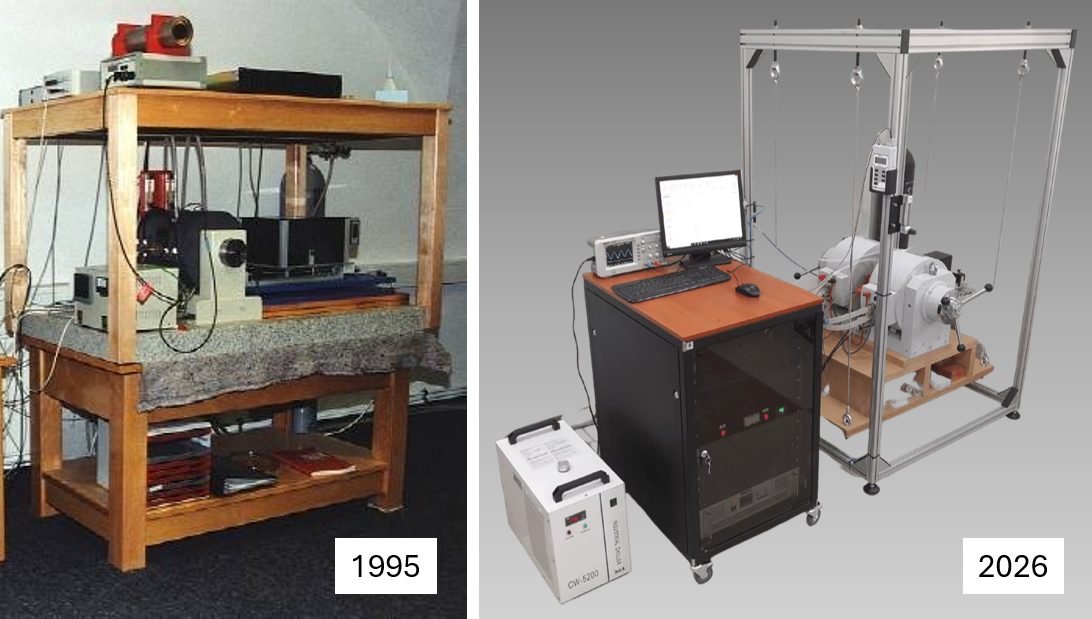
A few years ago my friend Przemek, an excelllent robotics engineer who also graduated from Waseda University in Japan, became interested in the technology of the VFTB and started a new company in Munich, Mag-Instruments, to further develop, manufacture and sell the machine my dad and me had created. Przemek turned our, in some ways still prototype, device into a state-of-the-art modern machine. The photos below show the journey from one of the first product versions we made, installed at GFZ in Potsdam, Germany, to the polished version that Mag-Instruments is selling now. What a transformation!